Optogenetics Solutions
Optogenetics is a groundbreaking technique that provides real-time, optical control of neuronal activity. Throughout the years, it has played a vital role in dissecting brain circuitry, probing the neural basis of behavior, modeling neurological disorders, and developing next-generation therapies in neuroscience.

The technique
The optogenetics approaches requires expressing opsins, light-sensitive ion channels or pumps, in a specific neuronal population. For chronic experiments, a fiber-optic cannula is surgically implanted above the target region to deliver a specific wavelength of light, activating or inhibiting the opsin-expressing cells. For example, blue light activates opsins like Channelrhodopsin (ChR2), while yellow or red light targets opsins such as NpHR or Jaws. For a list of available opsins, see the OPSIN APPLICATION NOTE.
At Doric Lenses, we offer a comprehensive range of light sources for optogenetics, all developed and manufactured in-house. In addition, we provide a complementary ecosystem of optical components such as light splitters, combiners, attenuators, optical rotary joints, patch cords, and cannulas—including components that combine optogenetics with other modalities (behavior, fiber photometry, Doric Miniscope, fluidics, electrophysiology, etc.).


Featured Products

Wireless Optogenetics
A cable free illumination for multiple, interacting animals. Ideal for recording / manipulating the neural populations underlying social behaviors.

DazzLED Light Source
High-throughput optogenetics stimulation: one light source for all your multi-animals and/or multi-site experiements.

LISER™ Light Source
A high-power, multi-color light source for most available opsins on the market.
Light Sources
Choosing the right light source is one of the most important steps when designing an optogenetics experiment.
Three broad categories of Light Sources: LEDs (regular, DazzLED and wireless, etc.), Laser Diodes, and LISER™. Each light source has different optical properties (emitter size, coherence, numerical apperture (NA), max power, max intensity, etc.) that makes it more of less optimized for different applications.
The optimal light sources depend on the:
- Opsin's excitation wavelength
- Opsin's intensity requirements,
- Size of the region(s)-of-interest,
- Number of regions-of-interest or animals excited simultaneously,
- Anticipated attenuation through the system (splitting, rotary joint, etc.)

|

|

|

|

|
|
Affordable choice to illuminate larger brain regions (400 µm +) |
Illuminate small brain regions (< 200 µm) with high intensity |
Multi-colour illumination, including 590 nm at high intensity |
High-throughput illumination for multi-site and/or multi-animal |
Cable-free illumination for freely-moving and/or interacting animals |
|
|
1 mm² |
50 µm² |
1 mm² |
9 mm² |
1 mm² |
|
|
400 µm - 1 mm |
50 µm - 200 µm |
200 µm - 1 mm |
200 µm - 3 mm |
200 µm or 400 µm |
|
|
High NA (0.57, 0.63) |
Low NA (0.22, 0.37) |
High NA (0.57, 0.63) |
High NA (0.37, 0.57) |
High NA (0.66) |
|
|
Moderate |
Very High |
High (especially at 590 nm) |
Moderate |
Low |
|
|
Incoherent |
Coherent (speckle) |
Incoherent |
Incoherent |
Incoherent |
|
|
365 nm - 900 nm (27 options) |
405, 450, 473, 488, 520, 638 nm |
Swap between 525, 559, 582, 593, 612 nm using bandpass filter. Add an additional blue light source. |
435, 450, 520, 620 nm |
465, 528, 634 nm |
|
|
Up to 4* fibers with SBP |
Up to 4 fibers using DMC |
Up to 4 fibers with SBP |
Up to 100 x 400µm fibers using LLG and BBP |
1 fiber |
|
|
$ |
$ |
$$$ |
$$ |
$ |
LEDs vs lasers?
LEDs vs lasers?
These two types of light sources differ in terms of emitter size, maximum intensity, maximum illumniation area and recommend fiber diameter and NA.
LEDs
LEDs are among the most commonly used light sources in optogenetics, suitable for experiments stimulating large regions-of-interest (with 400 µm - 1mm diameter) at moderate light intensities. Their large emitter, inherent safety, reliability, and affordability make them a preferred option across a variety of experimental designs.
At Doric Lenses, we offer a wide range of CLED wavelengths in the near-UV (350-400 nm), visible (400-700 nm) and near IR range (700-1100 nm) for standard optogenetic applications.
Laser Diodes
Laser diodes are high-powered light sources with small emitter ideal for optogenetic experiments requiring high intensity of light in small regions-of-interest (< 200um).
Their narrow beam profile and monochromatic light output make lasers ideal for illumination through small-diameter patch cords (typically 50–200 µm) and are a great solution when precise spatial targeting is required.
Unlike DPSS laser, laser diodes are not only more affordable, but also offer much faster response times, enabling rapid modulation of laser intensity and precise control of stimulation timing. This makes them particularly well suited for high-speed optogenetic applications, where millisecond-scale temporal precision is essential.
What's unique about the LISER™ light source?
What's unique about the LISER™ light source?
LISER™ (Laser-Induced Spontaneous Emission of Radiation) is an advanced light source providing high-intensity, broad-spectrum illumination. The system uses a laser pumped Ce:YAG (cerium-doped yttrium aluminum garnet) crystal, which emits a continuous spectrum from yellow to red (500–650 nm).
The LISER™ provides exceptionally high optical power (> 85mW full spectrum in a 200 um NA 0.57 fiber) in a spectral range that is difficult to achieve with standard LEDs or laser diodes, particularly around 590 nm, optimal for activating inhibitory opsins such as NpHR and Jaws. In addition to its broad-spectrum output, LISER™ includes an integrated blue excitation source (laser or LED), making it a versatile, all-in-one solution capable of supporting both excitatory and inhibitory optogenetics simultaneously.
The LISER also includes its own internal drivers, allowing independent control of two wavelength channels in the same brain region (e.g. 450 nm + 590 nm).
Key Features:
- Full-Spectrum Coverage: Simultaneously delivers blue excitation plus tunable yellow-red wavelengths using interchangeable optical filters (e.g., 525, 559, 582, 593, 612 nm).
- High-Power: Ideal for experiments requiring intense illumination, including bilateral, and/or large-area stimulation.
- Supports Large Core Patch Cords for wide brain region illumination: Optimized for 200 - 400 µm core diameters, enabling uniform wide-area stimulation.
What is optimal light source for multi-animal experiments?
What is optimal light source for multi-animal experiments?
For multi-animal or multi-site optogenetics experiments, DazzLED is the optimal solution. This light source can be combined with the DazzLED Fiber Converter and Bundle Branching Fiber Optic Patch Cords to deliver high-power stimulation across many fibers simultaneously.
This configuration enables scalable, high-throughput photostimulation of up to 20 fibers with 400 µm diameter cores or up to 100 fibers with 200 µm diameter cores, making it well suited for parallel optogenetic experiments, multi-region stimulation, and large cohort studies.
Can light sources be triggered by external device?
Can light sources be triggered by external device?
To operate Doric LED and Laser diode modules, a dedicated light source driver is required. The driver can either come as a standalone device, or can integrate the ligth source (fiber-light sources, FLS).
- Integrated Driver Units (FLS): In this setup, each driver channel has a built-in LED or laser, offering a compact and user-friendly solution.
- Modular Driver Setup (Driver): The LED/laser remains separate from the driver, provides flexibility to switch between different wavelengths.
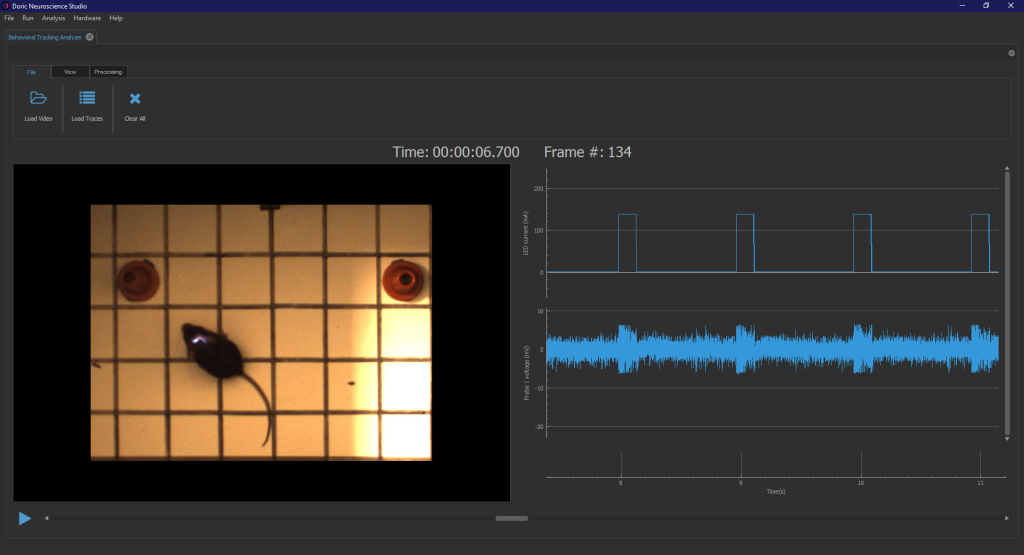
The driver can be operated in 1) standalone, 2) external modes (Analog or TTL), or 3) program sequences using free Doric Neuroscience Studio (DNS) software. In DNS, users can define a wide range of light stimulation patterns including continuous wave output, square pulse trains, sine waveforms, and cutoms waveforms.
Watch the tutorial video for step-by-step guidance on using LED drivers.
All light source drivers can be triggered by external digital signals, unlocking the ability to do close-loop experiments, where behaviors (lever press, nose poke, beam break, etc.) trigger the optogenetic stimulation. As such, DNS support complex triggering modes to pause, restart, and continue a stimulation pattern, as described in the following tutorial video.
NOTE:
- LED drivers are only compatible with LEDs, and LD drivers only with lasers.
- LISER come with integrated driver.
Rotary Joints / Commutators
Prevent optical fibers and cables from twisting and disrupting naturalistic animal behaviors during freely-moving experiments.

Choose your option

Choose your option

Choose your option

Choose your option

Choose your option

Choose your option

Choose your option

Choose your option

Choose your option

Choose your option

Choose your option

Choose your option

Choose your option

Choose your option

Choose your option

Choose your option

Choose your option
Defining the 1x1, 1x2 and 2x2 rotary joint nomenclature
Defining the 1x1, 1x2 and 2x2 rotary joint nomenclature
# x # refers to the division of optical channels above and below the rotary joint.
- 1x1 = single optical channel
- 1x2 = one optical channel that splits into two for bilateral optogenetics
- 2x2 two seperate optical channels for independent stimulation. Often used when combining fiber photometry and optogenetics.
Can electrical rotary joint be upgraded to opto-electric?
Can electrical rotary joint be upgraded to opto-electric?
Yes, but only for AERJ_24 and AERJ_24_RFMC. You can purchase Upgrade Kits to add an optical channel through the hollow central cannal of the electrical rotary joint.
Why are "pigtailed" rotary joint critical for fiber photometry?
Why are "pigtailed" rotary joint critical for fiber photometry?
Pigtailed rotary joint refer to built-in fibers within the rotary joint that cannot be detached.
These ensure the top and bottom fibers are well-aligned and significantly reduce the fluorescence fluctuations that occur during rotations in fiber photometry recordings.
***WARNING: Using non-pigtailed rotary joint can results in large motion artifacts in the fiber photometry signal.***
What is the dfference between "passive" and "assisted" rotary joints?
What is the dfference between "passive" and "assisted" rotary joints?
Passive rotary joint refer to non-motirized commutators that rely on the animals own force for rotation. The force required depends on the rotary joint and the internal fiction of the components. For a single optic-fiber on its own, the friction is quite low and no motirized assistance is required.
Assisted rotary joints are rotary joints with a motirized rotational component. This motorized approach is generally required when more than one optic fiber and/or electrical cables are added to the system. When there are multiple component, the friction during rotation becomes significant, requiring strong start up torque. Often times this start up force is too large for samll animals, like mice, and empedes naturalistic behaviors. Thus, motirized assistance ensure normal animal behavior.
Splitters
Devide the light from a single light source into multiple fibers for bilateral, multi-site and/or multi-animal experiments. The optimal splitter type depends on the light source (LED, LISER or laser diode), the intensity requirements and the size of the region-of-interest.

Splitting Branching Patch Cords
- Split in up to 4 outputs
- Ideal for LED or LISER™
- Simple and low-cost
- Compatible with high & low NA

Doric Mini Cube - intensity division
- Highest efficiency with laser diodes
- Handles higher power
- Up to 4 outputs
- Recommended for low NA fibers
Combiners
Deliver multiple wavelengths of light to the same target region.

Doric Mini Cube - wavelength division
- Combine up to 4 colours in 1 fiber
- Compatible with ALL light sources
- Ideal for low & high NA fibers

★LISER™ Light Source
- Combines blue + yellow/red in 1 fiber
- High-intensity illumiation @ 590 nm
- Swap filter to select yellow/red range
- Ideal for high NA fibers
- Combines readily with rotary joint

Combined LEDs
- Integrate up to 4 LEDs into 1 fiber
- Ideal for high NA fibers (0.57, 0.63)

Combined LEDs with Fiber-optic Rotary Joint
- Integrate up to 4 LEDs into 1 fiber
- Ideal for high NA fibers (0.57, 0.63)
- Optimized for freely-moving animals
Fiber-optic Patch Cords
Deliver optogenetic illumination in one, two of more regions-of-interests / animals. Note that the recommended material, diameter and numerical apperture differs depending on the light source and experimental requirements.

Mono Fiber-Optic Patch Cord
Simplest fiber optic for basic single fiber optogenetic applications. Comes in a variety of ferrles types compatible with all Doric Mono-fiber optic cannulas.

Dual Fiber-Optic Patch Cord
Maintains two seperate optical channel on the input and output. Compatible with Dual-fiber cannula, for bilateral or dual-site stimulation.

Bundle-Branching Patch Cord
Contains multiple fibers in a single connector that branche into multiple mono fiber connections. Recommend for DazzLED.
Splitting-Branching Patch Cord
Divides the light from a single fiber into 2-4 outputs for bilateral / multi-site stimulation using a single light source.
Recommend patch cord for LEDs / LISER™
Recommend patch cord for LEDs / LISER™
For an LEDs, use a large-core, high-NA patch cord, typically 400–600 µm core with NA 0.57 (sillica/polymer) or 0.63 (plastic), to maximize light collection and coupling efficiency.
Recommended patch cord for laser diaodes
Recommended patch cord for laser diaodes
Use a small-core, low-NA patch cord to match the laser diode output, typically 50–200 µm core with NA 0.22–0.37. This improves coupling efficiency and limits beam divergence compared with a large-core, high-NA fiber.
For Doric laser diodes, it is important to use FCA connector (FC/PC with angle) to prevent backreflection that can damager the laser over time.
Why is the numerical apperture important?
Why is the numerical apperture important?
Numerical aperture (NA) describes the range of angles a fiber can accept and emit light.
In optogenetics, higher NA generally improves light collection and delivers light over a wider angle, while lower NA produces a narrower beam that tends to penetrate with higher depth.
Matching the NA to the light source helps maximize coupling efficiency.
Fiber-optic Cannuals

Choose your option

Choose your option

Choose your option

Choose your option

Choose your option

Choose your option

Choose your option

Choose your option

Choose your option

Choose your option

Choose your option
What fiber core diameter and NA recommendation?
What fiber core diameter and NA recommendation?
Generally, its a good rule of thumb to match the NA and diameter of the cannula to the NA of the patch cord/rotary joint.
However, while some materials (sillica/polymer) have properties like flexibility that are ideal for patch cords, it doesn't necessarily mean those properties are ideal for implants.
For high NA (LEDs/LISER™)
We recommend pairing 0.57/0.63 patch cords with 0.66 borosillicate cannulas. In this case, the smallest NA of all the optical component is the effective NA of the system.
For low NA (laser diodes)
We recommend matching the NA. 0.22 -> 0.22 and 0.37 -> 0.37
Recommended patch cord for laser diaodes
Recommended patch cord for laser diaodes
Use a small-core, low-NA patch cord to match the laser diode output, typically 50–200 µm core with NA 0.22–0.37. This improves coupling efficiency and limits beam divergence compared with a large-core, high-NA fiber.
For Doric laser diodes, it is important to use FCA connector (FC/PC with angle) to prevent backreflection that can damager the laser over time.
Why is the numerical apperture important?
Why is the numerical apperture important?
Numerical aperture (NA) describes the range of angles a fiber can accept and emit light.
In optogenetics, higher NA generally improves light collection and delivers light over a wider angle, while lower NA produces a narrower beam that tends to penetrate with higher depth.
Matching the NA to the light source helps maximize coupling efficiency.
Combine your system with...

Choose your option

Choose your option

Choose your option

Choose your option

Choose your option

Choose your option

Choose your option

Choose your option

Choose your option

Choose your option

Choose your option

Choose your option

Choose your option
Choose your option
Choose your option
Choose your option
Choose your option

Choose your option
Choose your option

Choose your option

Choose your option
Choose your option

Choose your option

Choose your option

Choose your option

Choose your option

Choose your option

Choose your option

Choose your option

Choose your option
Choose your option

Choose your option

Choose your option
Doric Neuroscience Studio